Monthly Archives: July 2010

Ursula K Le Guin Reviews The Elephant’s Journey by José Saramago

I first began reading Saramago in 1999, a year after he won the Nobel Prize in Literature. His writing was like nothing I had read before– erudite, playful, inventive, challenging, sometimes maddeningly discursive, but always humane, always compassionate. I read the rest of his novels as quickly as I could obtain them and was looking forward to the release of The Elephant’s Journey in 2010.

Earlier this summer, I was at Pacific University when I learned that José Saramago had died. It was surprising how much this news disconcerted me, as if I had learned a favorite uncle had died. Two days later I was having coffee with one of the faculty when, assuming she had heard the news, I noted Saramago’s death. She had not heard the news and her initial reaction was much like mine. We sat together for awhile saying nothing, an odd but comforting moment, two people reflecting on the loss of someone neither had met but that each felt they knew.

via The Guardian:

The Elephant’s Journey by José Saramago

“The past is an immense area of stony ground that many people would like to drive across as if it were a motorway, while others move patiently from stone to stone, lifting each one because they need to know what lies beneath. Sometimes scorpions crawl out or centipedes, fat white caterpillars or ripe chrysalises, but it’s not impossible that, at least once, an elephant might appear. . .”

When he died last month, the man who wrote those words in The Elephant’s Journey, José Saramago, was an old man, 87 years old. His preoccupations and politics and passions might seem to belong to a past age: a diehard communist impatient of dictators, subversive of orthodoxies, disrespectful of international corporations, peasant-born in a marginal country and identifying himself always with the powerless, a radical who lived on into an age when even liberals are spoken of as leftist . . . But the still more intransigent radicalism of his art makes it impossible to dismiss him from the busy chatrooms of the present. He got ahead of us; he is ahead of us. His work belongs to our future. I take comfort in this. As we patiently lift stones in the endless fields of modern literature, we must expect scorpions and grubs, but it is now certain that, at least once, an elephant has appeared.

Add to FacebookAdd to DiggAdd to Del.icio.usAdd to StumbleuponAdd to RedditAdd to BlinklistAdd to TwitterAdd to TechnoratiAdd to Yahoo BuzzAdd to Newsvine

Leave a comment

Filed under Uncategorized

Traditional Publishers Take Another Hit

via The New York Times

Literary Agent Plans E-Book Editions

The literary agent Andrew Wylie  said on Wednesday that he would begin his own publishing venture, called Odyssey Editions, which will produce e-book editions of titles by some of his clients, including Saul Bellow, John Updike and Philip Roth. Mr. Wylie said his new company would focus on older titles whose digital rights are not owned by traditional publishers

Stories like this became inevitable as e-readers gained traction. Digital text so undercuts the resources the big publishing houses have to offer– printing presses, marketing budgets, relationships with the mega-bookstores–  that “name” authors can bypass long established distribution channels and sell their work directly to the reader, with amazon.com and other sites serving as conduits. The publishers are howling but it’s really far too late.

Lesser stars in the literary firmament will, I think, benefit as well from these shifts– their work will no longer go out of print or be tossed into remainder bins at the giant mall bookstores to make way for the next Dan Brown commodity, instead staying permanently and instantly available online. And unlike used books, they will get paid for each sale.

For unknown writers, the rise of digital text is a very exciting development, with lots of new opportunities to get work out into the wilds. I don’t know how many folks will still be interested in books (digital or otherwise) as the future comes avalanching down upon us, but at least it will be available should they choose to enjoy the analog pleasures of reading.

Add to FacebookAdd to DiggAdd to Del.icio.usAdd to StumbleuponAdd to RedditAdd to BlinklistAdd to TwitterAdd to TechnoratiAdd to Yahoo BuzzAdd to Newsvine

1 Comment

Filed under Uncategorized

Two of My Favorite Things

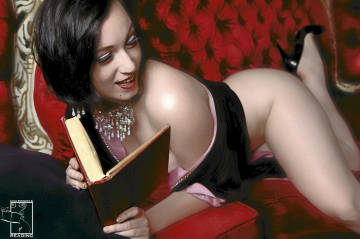
I read this for a laugh, then got to these quotes from one of the performers–

“The work is close to the heart,” L’amour says. “We have an emotional connection to the pieces we have chosen.”

L’amour points out that the repeat audience at her salons come because of the readings. “They’ve already seen us naked, so that’s routine for them,” she says. “They come to hang on every word.”

The Globe and Mail article does a pretty fine job of illuminating the humanity of the story instead of just hyping the lurid stuff– there’s something kind of moving about the whole enterprise.

Naked girls reading? Burlesque turns a page


It has to be the most provocative literary series in the world with a title like “Naked Girls Reading,” but it’s exactly as advertised. Burlesque divas remove the pasties and G-strings – those time-honoured barriers to complete nudity – and grab a book.

And it’s an all-star international lineup of naked readers who kick off the five-day, third-annual Toronto Burlesque Festival at the Gladstone Hotel Wednesday night. NGR, in fact, is the newest phenomenon of the phenomenal burlesque revival.

Add to FacebookAdd to DiggAdd to Del.icio.usAdd to StumbleuponAdd to RedditAdd to BlinklistAdd to TwitterAdd to TechnoratiAdd to Yahoo BuzzAdd to Newsvine

Leave a comment

Filed under Uncategorized

Be the Book

Meh. Not impressed. Blood is easily drawn and regenerates fairly quickly. Now anthropodermic bibliopegy— there’s real commitment.

via The Telegraph:

Book made with Sachin Tendulkar’s blood to cost £49,000
In a bizarre marketing strategy, a luxury book publisher is bringing out a special edition biography of Tendulkar with pages made from his blood. The “blood edition”, which also includes unpublished family pictures and Tendulkar’s thoughts about his career, weighs 37kg and contains 852 pages all edged in gold leaf, the Guardian reports. Due to be released next February, The Tendulkar Opus has a price tag of £49,000. Only 10 copies will ever be made and all have been pre-ordered.

Add to FacebookAdd to DiggAdd to Del.icio.usAdd to StumbleuponAdd to RedditAdd to BlinklistAdd to TwitterAdd to TechnoratiAdd to Yahoo BuzzAdd to Newsvine

Leave a comment

Filed under Uncategorized

The Consolations of Technology

* background post

A Call From The Equalizer

Any poet who had work accepted by The Paris Review and has received notice that their poems will no longer be published due to the editorial changes at the magazine are encouraged to submit those poems for consideration to The Equalizer, a new PDF-based journal which I’m assembling right now for a September/October 2010 launch.

What’s interesting about this new development is that it really encapsulates the intersection/abrasion between traditional print and digital media. One of the main factors in this whole saga is the time lag between acceptance and publication inherent in creating print magazines. Things can and do change, editors included. With digital media, a collection of poems (or stories or images or audio/video, or any combination) can be assembled rapidly and instantly disseminated online to computers, smartphones, and digital readers. Lag is minimized, a significant benefit to both the writer and the reader.

Currently, paper magazines still have the edge as far as institutional support, editorial judgment, and the pool of writers they can draw from, but these advantages will not be enough to counter the low start-up costs, global reach, and the sheer nimbleness of digital mags. And as the quality of writing online improves, the deficiencies of the old model can only become more pronounced.

Add to FacebookAdd to DiggAdd to Del.icio.usAdd to StumbleuponAdd to RedditAdd to BlinklistAdd to TwitterAdd to TechnoratiAdd to Yahoo BuzzAdd to Newsvine

1 Comment

Filed under Uncategorized

Wow… just, wow…

“Hi, Paris Review here. Remember those poems we accepted from you? Umm…”

Behind the scenes at The Great Paris Review Poetry Purge of 2010: part 1.

Dear XXXX,

Recently I replaced Philip Gourevitch as editor of The Paris Review and appointed a new poetry editor, Robyn Creswell. Over the last month, Robyn and I have been carefully reading the backlog of poetry that we inherited from the previous editors. This amounts to a year’s worth of poems. In order to give Robyn the scope to define his own section, I regret to say, we will not be able to publish everything accepted by Philip, Meghan, and Dan. We have not found a place for your three poems, though we see much to admire in them and gave them the most serious consideration. I am sorry to give you this bad news, and I’m grateful for your patience during the Review’s transition.

Best regards,
Lorin Stein

Add to FacebookAdd to DiggAdd to Del.icio.usAdd to StumbleuponAdd to RedditAdd to BlinklistAdd to TwitterAdd to TechnoratiAdd to Yahoo BuzzAdd to Newsvine

Leave a comment

Filed under Uncategorized

Fairy Tales… with Fangs

I’ve always like twisted fairy tales, maybe because I grew up in Hawaii where “chickenskin” stories about Pele’s curse or the Nightmarchers were more popular than treacle like Cinderella or Snow White (or at least the Disney versions– the original Brothers Grimm stories are full of cannibalism, torture, and dead children).

A review from the Seattle PI:

These Children Who Come at You With Knives, and Other Fairy Tales by Jim Knipfel

In These Children Who Come at You With Knives, and Other Fairy Tales, brilliance is rewarded with torture, beauty is its own punishment, and outrageous good fortune always turns to crap. The only thing worse than being the victim of some of the malevolent creatures in these fairy tales is to be their beneficiary. Twisted? You bet! Entertaining? And how!

And a NYT review of an excellent collection I came across last year:

There Once Lived a Woman Who Tried to Kill Her Neighbor’s Baby: Scary Fairy Tales by Ludmilla Petrushevskaya

Ludmilla Petrushevskaya was born in Moscow in 1938, at the height of the Stalinist terror, at a time when the Soviet Union was on the brink of war. For decades, censors shunned her fiction because of its impolitic bleakness, and she survived by working as an editor and translator, writing plays and television and radio scripts (when she could), and selling the occasional newspaper article. But with the rise of perestroika and the fall of Communism, she has been rehabilitated, and today is hailed as one of Russia’s best living writers.

Add to FacebookAdd to DiggAdd to Del.icio.usAdd to StumbleuponAdd to RedditAdd to BlinklistAdd to TwitterAdd to TechnoratiAdd to Yahoo BuzzAdd to Newsvine

Leave a comment

Filed under Uncategorized

Listening to Writing (Part 2)

*hat tip to Electric Literature’s excellent tweets

From Open Culture:

20 Great Authors (and Actors) Read Famous Literature Out Loud

Every now and then, we like to present vintage clips of great authors reading classic literary works – works they have often written themselves. These clips can be fairly revealing. Through them, you can recapture the voices of literary greats, most long since passed. And you can hear how they give character and expression to their own works … or those of others. In response to a reader’s request, we have pulled together some of the finest examples previously featured here. And, for good measure, we’ve added prime clips of famous celebrities giving literary readings too. Hope you enjoy (and share):

1) William Faulkner Reads from As I Lay Dying

2) James Joyce Reading Finnegans Wake

3) Vintage Radio: Aldous Huxley Narrates Brave New World

More at link.

Add to FacebookAdd to DiggAdd to Del.icio.usAdd to StumbleuponAdd to RedditAdd to BlinklistAdd to TwitterAdd to TechnoratiAdd to Yahoo BuzzAdd to Newsvine

1 Comment

Filed under Uncategorized

Pointer #3 – PANK Magazine

* Online lit mags are publishing some of the most intriguing writing available today. Every Monday, I post a pointer to a site that offers fiction and/or poetry either as free content or as samples from subscriber issues.

Today’s pointer is to PANK:

To the end of the road, the edge of things, a north shore, up country, a place of amalgamation and unplumbed depths, where things are made and unmade, and unimagined futures are born. To a kind of ultima Thule. Inhabit your contradictions. Squeeze your quirk and anomaly. No soft pink hands.

From their listing on Duotrope:

We are extremely committed to our writers and promote their work both in PANK and in other magazines, whenever we can.We also try to send personal feedback with as many submissions as we can.
—Roxane Gay, Co-Editor on 24 May 2010

PANK publishes Poetry, Flash Fiction, and Short Stories. “In 2009, across print and digital platforms, PANK had more than 80,000 readers in 138 countries.”

Poetry excerpt from Johnsie Noel’s,  TO UNDERSTAND STRING THEORY:

At the ages of six and nine
we understood simply
the ‘theory of everything.’
The 11th dimension was
condensed down
to – a ball of twine
unwound, vibrating secrets

Fiction excerpt from Robb Todd’s, GRACIAS, PERO SI

There is a heat here, a different heat, and there is a sweat here, a permanent sheen on the forehead that everyone wears because air conditioning is for the weak. A fan and a breeze is enough and you get used to the slick skin. A handkerchief or bandanna is suddenly in style. People only linger in shade.

Add to FacebookAdd to DiggAdd to Del.icio.usAdd to StumbleuponAdd to RedditAdd to BlinklistAdd to TwitterAdd to TechnoratiAdd to Yahoo BuzzAdd to Newsvine

Leave a comment

Filed under Uncategorized

Terrific Interview w/ David Means

via The Rumpus:

Rumpus: In terms of how you work, how many drafts do you usually put your stories through? How planned out are they in advance, and what do you start with?

Means: I could never plan them out in advance beyond a small seed, maybe an image, or a character in a specific predicament.  I might have more of a story in mind, but I hold it for a long time before I write about it.  I’m still holding onto all of my family stuff.  When I’m ready, when I’m inspired, I’ll start to write a rough draft by hand.  After typing it up, sometimes months later, I’ll begin to revise.  Some stories take many, many drafts over a long period of time.  Each story has its own set of demands.  I think it was William Maxwell who said you need to respect the story as much as possible.  I throw stories away.  Sometimes I hold onto the early draft for a few years and let my subconscious do the work. I have a long credo tacked to the wall.  Part of it says:  “Do not compromise.  Go as deep as you can.  If in the end it has to be thrown away, throw it away.”

Add to FacebookAdd to DiggAdd to Del.icio.usAdd to StumbleuponAdd to RedditAdd to BlinklistAdd to TwitterAdd to TechnoratiAdd to Yahoo BuzzAdd to Newsvine

Leave a comment

Filed under Uncategorized