Category Archives: Uncategorized

Booksellers as Publishers

Interesting article. Independent bookstores have been taking a beating for decades, first from chains like Barnes & Noble and Borders, then from Internet overlord Amazon.com, and now the rise of ebooks.

via Salon.com:

Indies battle Amazon — by becoming publishers

As publishers, indies enjoy a few distinct advantages over the competition. First, they can emphasize titles of local interest by local writers. Second, they can showcase the books in their shops. Third, because of advances in printing, they can bring books to market more quickly than traditional publishers. Just as important, when an independent bookstore sells a copy of one of their own titles, they collect all the profits, rather than a sliver. Consider it a poor man’s version of vertical integration.

Kaplan told me he hoped other bookstores would take up small-scale publishing. That’s already happening.

Leave a comment

Filed under Uncategorized

Literary Pulp

Happy Halloween, lit geeks.

via Daily Beast:

Horror Goes Highbrow
With Colson Whitehead writing a zombie novel and “Granta” releasing a horror issue, monsters and scares aren’t just the domain of mass market anymore. Josh Dzieza on why we relish well-written fright.

It’s a good time to be a horror fan. Vampires, zombies, and their ilk, in their seemingly unstoppable spread across the culture, are shedding the ghettoization of genre and striving for respectability alongside mainstream dramas. When The Walking Dead came to AMC last year, critics questioned whether it belonged with the likes of Mad Men and Breaking Bad. But it looks like the zombies made it: It was renewed for a third season after the second debuted to the largest basic-cable audience ever.

Monsters have been climbing up the literary hierarchy as well. When the first installment of Justin Cronin’s vampire saga, The Passage, came out last year, it was marketed not as pulp genre fare but as a serious novel, with emphasis on Cronin’s literary bona fides—his degree from the Iowa Writers’ Workshop and his PEN/Hemingway award. Last summer Glen Duncan gave us an erudite werewolf coping with ennui as he evades assassination by the heirs of Van Helsing, and Benjamin Percy, author of the acclaimed short-story series Refresh, Refresh, is working on a werewolf novel of his own, called Red Moon, the story of persecuted Lycans and a clash between xenophobic civilizations.

Now, with Colson Whitehead’s Zone One, readers looking for a literary zombie novel are no longer limited to Jane Austen mashups.

Leave a comment

Filed under Uncategorized

Nom Nom Nom

I loves me a good zombie story, so I was pleased to hear about Colson Whitehead‘s new novel, Zone One. Besides being a terrific writer, his tweets are funny as hell. Predictably, however, the reviewers of Zone One have had some trouble with the notion of of a literary writer writing about zombies. Publishers Weekly : “Whitehead dumpster dives genre tropes, using what he wants and leaving the rest to rot…” Kirkus: “[H]e sinks his teeth into a popular format and emerges with a literary feast…” Damn, condescension  just put on a tweed jacket and grew a salt-and-pepper beard. (Though it is kind of funny to see Amazon’s “Customers Who Bought This Item Also Bought” list Eugenides’s The Marriage Plot alongside The Walking Dead: Rise of The Governor)

Via The Atlantic:

Colson Whitehead on Zombies, ‘Zone One,’ and His Love of the VCR

Outside of the world of general horror, there’s something specifically enticing about zombies right now. I’ve heard so many people say, breathlessly, “Colson Whitehead’s writing a zombie book.” What is it about the word “zombie” that gets people so excited?

In the last ten years, there’s been a resurgence in all kinds of zombie culture. Why are zombies important or interesting now? I have no idea. I wrote Zone One because I wanted to fulfill my own curiosity—which goes back decades—about the creatures.

So in terms of larger cultural trends, I have no idea. In terms of me, I became demonically attached to Night of the Living Dead, Dawn of the Dead, and Day of the Dead, the first George Romero trilogy. Zone One comes out of me trying to work through some of my ideas about why, for me personally, zombies are scary.

Leave a comment

Filed under Uncategorized

Weekend Reads

Wandered into the local big box bookstore, found three newly released novels by three of my favorite authors.

*

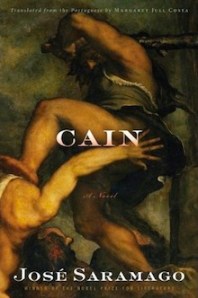
Cain by José Saramago

Via The Independent:

Saramago is a first-person narrator who keeps himself just out the corner of your eye. He’s often funny, and thought-provoking, and delightfully mischievous, savouring the details of his own defiance. Every little barb, every little twist is absolutely deliberate. Translator Margaret Jull Costa carefully holds the thread of his winding sentences, which snake across pages and pages, running right through the direct speech, one sentence sometimes covering entire, fully-realised arguments and half a dozen switches in register, one moment Biblical-stately, the next earthy and idiomatic. The lord is glorious, magnificent, almighty, eternal, splendid, and also just a son of a bitch.

Cain was composed shortly before Saramago’s death last June aged 87. It’s apparent just how his ferocious intelligence and argumentative atheist glee still blazed. And it’s impossible to imagine he didn’t relish the writing of it.

*

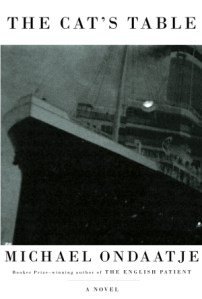
The Cat’s Table by Michael Ondaatje

Via The New York Times:

Reading Michael Ondaatje’s mesmerizing new novel, “The Cat’s Table,” is like being guided, just as surely and just as magically, through the author’s lustrous visions. As he did in his great 1992 novel, “The English Patient,” which won the Man Booker Prize and became an Academy Award-winning film, Ondaatje conjures images that pull strangers into the vivid rooms of his imagination, their detail illumined by his words.

In “The Cat’s Table,” Ondaatje seems to lead the reader on a journey through three deeply submerged weeks in his own memory — from the year 1954, when, at age 11, he traveled on the ocean liner Oronsay from Colombo, in what was then Ceylon, to England, a passage that would lead him from his past to his future self. As the novel opens, prominent passengers are granted seats at the captain’s table, but young Michael (nicknamed Mynah) and the two boys he befriends, Cassius (a troublemaker) and Ramadhin (a contemplative asthmatic), are relegated to a table of dubious characters: a mute tailor, a retired ship dismantler, a pianist who has “hit the skids,” a botanist and a lady who hides pigeons in the pockets of her jacket, and reads thrillers in her deck chair, flinging them overboard when they bore her. It’s the pigeon lady who remarks that theirs is “the cat’s table” since “we’re in the least privileged place.”

*

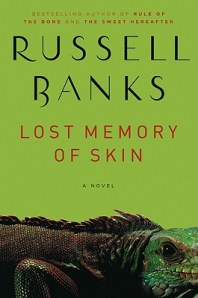
Lost Memory of Skin by Russell Banks

via The New York Times:

“I was a New England kid, coming out of that world,” [Banks] said, smoking a cigarette on the balcony of his new high-rise apartment overlooking Biscayne Bay. “All of a sudden I could smell the Gulf Stream. There were palm trees, and people who didn’t look like me, sound like me. Half a century later, I still get off the airplane and feel the same rush, that same hit. ”

Mr. Banks is now 71. Burly and white-bearded, he looks a little like Hemingway, if Hemingway could have been persuaded to wear a diamond chip in his left ear. He still speaks with traces of a New Hampshire accent, and when not in Florida he lives in Keene, N.Y., 100 miles from the Canadian border. “I guess I just like the extremes,” he said. “Not the middle.”

Leave a comment

Filed under Uncategorized

Technology and Memory

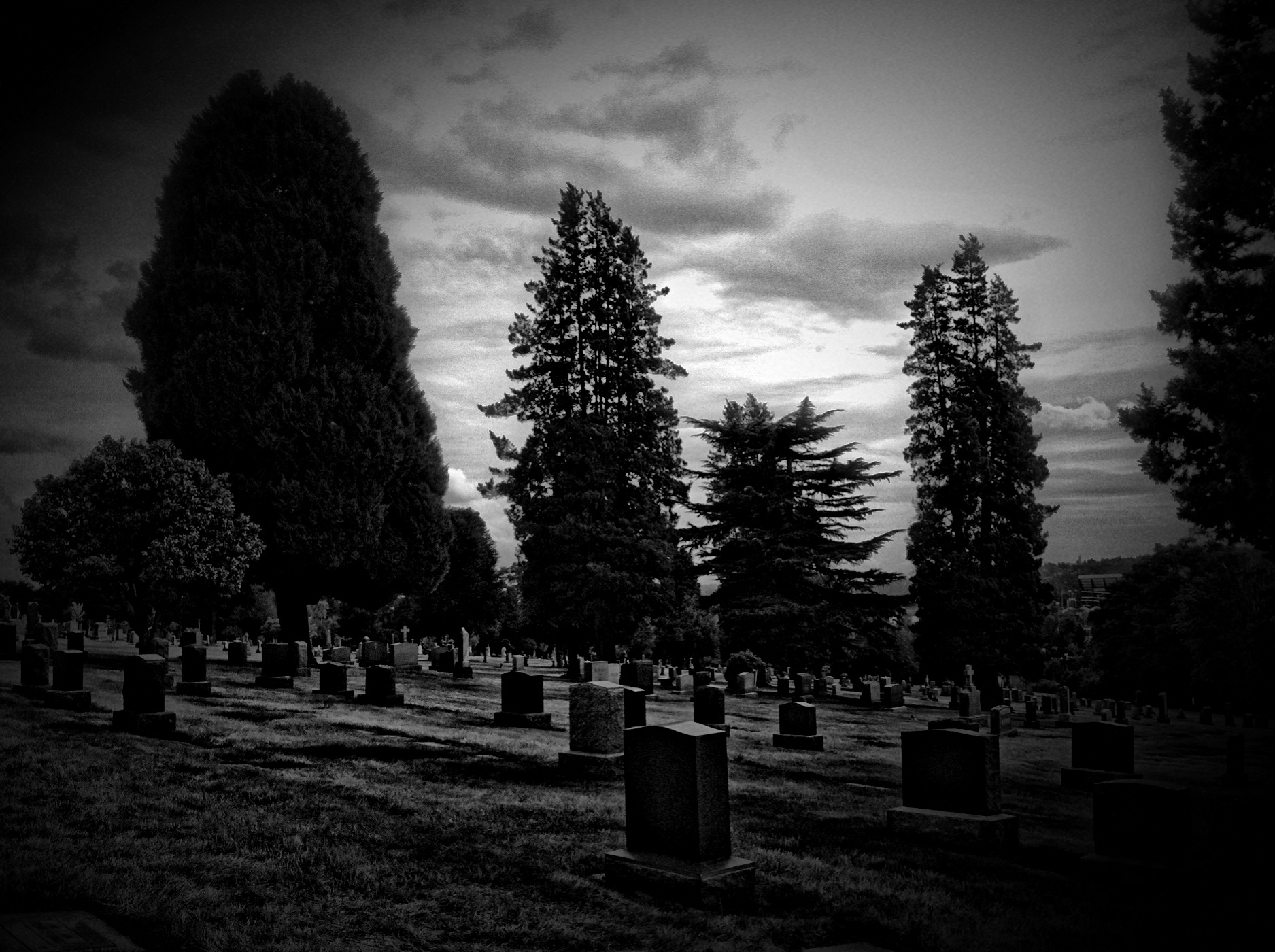
Spent the weekend in Seattle. Wandered into a cemetery and took the picture below. I never carry a camera with me, but my phone has one built in. More and more, I find myself recording moments in ways I didn’t before I got the phone. What used to be memories in my head are now preserved digitally, available to be manipulated and filtered for aesthetic effect, the relationship between what I remember and what I’ve created altered in fundamental ways that I’m not sure are good or bad, but are definitely different.

Cemetery in Seattle. September 17, 2011

Leave a comment

Filed under Uncategorized

American Gods Coming to HBO

After kicking ass with Game of Thrones, HBO snags Neil Gaiman’s American Gods.

via The Guardian:

Neil Gaiman to adapt novel American Gods for HBO

Neil Gaiman talks to John Mullan at the Guardian Book Club at the Edinburgh international book festival. Photograph: Murdo Macleod

Neil Gaiman is to start work “in a couple of weeks” on adapting his bestselling novel American Gods into a TV series for the American cable channel HBO.

Speaking at the Guardian Book Club at the Edinburgh international book festival, the author said: “I got the email yesterday saying that the final contractual tos and fros have been sorted out and I should be free within a couple of weeks to start writing.”

Gaiman, 50, is the British-born, US-based novelist, short-story writer and screenwriter widely regarded as having redefined the graphic novel, notably with his comic book series The Sandman.

His first “straight” novel, Neverwhere, was a version of his 1996 BBC screenplay of the same name. American Gods is his bestselling novel which, on the 10th anniversary of its publication this year, was re-published with an extra 12,000 words of material that had been excised from the first edition.

Leave a comment

Filed under Uncategorized

Post-Clarion Thoughts

As I posted earlier, Clarion was a tremendous experience for me. I worked with six strong faculty and hung out with writers like Kim Stanley Robinson and David Brin. Most importantly, I got to know seventeen other writers that I respect and plan to stay in touch with.

It’s been a week since I got home from San Diego and I’m still feeling somewhat unmoored. After six weeks devoted to nothing but writing, returning to the daily slog has been disconcerting and a bit sad.
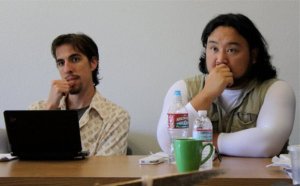
Workshop Critique Session (photo by Jasmine Stairs)

Blogs by other Clarion 2011 students can be found in my Links. Below are just a couple of brief thoughts on my Clarion experience.

* The instructors were less important than the students.

This was the most important thing I discovered about Clarion. The guest writers set the tone for each week and offered valuable insights into writing, but it was the quality of my classmates that really mattered. I was fortunate– Clarion 2011 assembled a group that was talented, smart, and genuinely caring. The stories written during the workshop were amazingly strong and the critiques were sharp and insightful. While the visiting writers were very helpful, the core of the workshop was definitely the eighteen of us and the work we did together.

* The pace can be relentless if you don’t manage your time well.

San Diego is beautiful and UCSD is a sprawling, lively campus. Add in Comicon, trips to the beach, weekly faculty readings, and reading past students’ work at the Clarion archives (the workshop stories of Ted Chiang, Kelly Link, and Nalo Hopkinson blew me away), and time for critiquing and writing can rapidly diminish.

My approach to the workshop may be anomalous. I did not attend any of the readings or go to Comicon or hang out in the common room with the other students (this last choice is my only regret about Clarion). I knew that I was a slow writer and as the recipient of the Octavia Butler Scholarship, I also felt a responsibility to make my time at Clarion as productive as possible. Despite knowing how I worked and the limits of my energy, I still struggled to keep up with the schedule. I did manage to turn in a story each week until Week 6, when my brain simply cramped up. By the end of the workshop, I was mentally drained and very sleep deprived.

The upside to the demanding pace was that it forced me to plow through a draft instead of constantly going back and tinkering. It also taught me that I could crank out pages even when my “muse” was feeling grumpy.
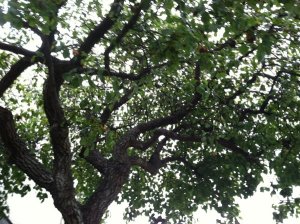
The tree outside my apartment provided shade and a place to smoke.

Clarion was an intense and at times frustrating experience. Six weeks is a long time– the food got monotonous, the beds were uncomfortable, and the campus is hilly and prowled by skunks. Several of my classmates made life changing decisions while attending and others had no jobs to return to when the workshop was over. Despite all this, our class was remarkably cohesive. We treated each other with respect and consideration because we genuinely liked each other. This more than any other factor, I think, is what made Clarion such a remarkable experience for me.
6 Comments

Filed under Uncategorized

One Week Left at Clarion

This has really been a tremendous experience, hard to believe that I’ve been in San Diego over a month. I’ll post a write-up of the workshop when I get home. Until then, here’s some pictures.

Me and Kim Stanley Robinson

Sunset over the UCSD dorms.

2 Comments

Filed under Uncategorized

And what rough beast, its hour come round at last, Slouches towards San Diego to be born?

Six weeks geeking and freaking at UCSD.

Established in 1968, the Clarion Writers’ Workshop is the oldest workshop of its kind and is widely recognized as a premier proving and training ground for aspiring writers of fantasy and science fiction.

Our 2011 writers in residence are Nina Kiriki Hoffman, John Scalzi, Elizabeth Bear, David Anthony Durham, John Kessel and Kij Johnson

Leave a comment

Filed under Uncategorized

Literary LOLz, Weekend Edition

The ubiquitous James Franco, The Sound of a Wild Snail Eating, and Jonathan Franzen getting irritated.

via Salon.com:

Moby Awards honor best, worst book trailers of 2011

On the surface, book trailers seem like a fairly ridiculous concept: trying to market literature to people who would rather wait until the movie version comes out. Most of the time, publishing houses create trailers that are visually arresting or entertaining, but have nothing whatsoever to do with the book they’re trying to sell. That’s where the Moby Awards  come in.

Celebrating the best and the worst of book trailers with a statuette of a golden sperm whale, last night’s Second Annual Moby Awards were held at the Powerhouse Arena in Brooklyn. With categories like “Most Celebtastic Performance,” “Best Small House Press Trailer” and “What Are We Doing to Our Children? (good or bad, you decide),” the ceremony is more tongue-in-cheek McSweeney’s party than Paris Review gala.

Leave a comment

Filed under Uncategorized