Pointer #7 – elimae

* Online lit mags are publishing some of the most intriguing writing available today. Every Monday, I post a pointer to a site that offers fiction and/or poetry either as free content or as samples from subscriber issues. Today’s pointer is to elimae

from elimae’s Information page:

elimae, pronounced el-ee-may, and standing for electronic literary magazine, was founded by Deron Bauman in 1996 and has published essays, fiction, interviews, poetry and reviews. At the end of 2004, Bauman departed to concentrate on other responsibilities, and the editorship was assumed by Cooper Renner.

fiction excerpt:

I Can Only Do Great Things If You Die
Steve Stringer

I made an evening of drinking mojitos and googling photos of the world’s tallest man and thought surely this giant will die soon, and he did the following morning. Giants never last long. I felt implicated in his death, so the next night I ate Mexican and drank margaritas — on the rocks with salt — in his honor.

poetry excerpt:

Variations on the Expulsion from Eden
Eliza Victoria

i. Adam and Eve as Evicted Tenants

We wager you wanted us to do it, giving us this place for free, allowing us to re-paint the walls, rearrange the existing furniture.

Cerise, we decided to call it, and we rolled up our sleeves and applied the coat in clean, thick strokes, watching, amazed, as the paint dried, accepting its definition.

Rose, we whispered to each other, and we licked each other’s nipples, each others cheeks.

Add to FacebookAdd to DiggAdd to Del.icio.usAdd to StumbleuponAdd to RedditAdd to BlinklistAdd to TwitterAdd to TechnoratiAdd to Yahoo BuzzAdd to Newsvine

3 Comments

Filed under Uncategorized

Weekend Stories – 8.16.2010

Some interesting articles you may have missed over the weekend include 17 Literary Journals That Might Survive The Internet, 13 Literary Magazines Reviews, more on self-publishing, and what Joyce Carol Oates is excited to read.

*

Anis Shivani follows up his provocative list of the 15 Most Overrated Contemporary American Writers with 17 Literary Journals That Might Survive The Internet. The usual suspects are gathered while several notables (Tin House, Glimmer Train) are oddly neglected. As Susan Schultz commented below the article, “Iowa Review seems to be the furthest west of these–almost all are staunch east coast institutions. Look farther west! There are good journals in California and, gasp, Hawai`i!”

via Huffington Post:

Anis Shivani:17 Literary Journals That Might Survive The Internet (PHOTOS)

How are the literary journals faring amidst the rise of the Internet? Are they suffering from the current cost-cutting mania in higher education? Can this venerable American literary institution survive–or even thrive–despite new technologies?

The respected editors of some of America’s most venerable little magazines answered these questions for us.

*

via newpages.com:

Literary Magazine Reviews
Aufgabe, Number 9, 2010
Review by Sima Rabinowitz

An engaging and provocative issue of this ever-impressive annual. This year’s portfolio of international writing features contemporary Polish poetry selected by guest editor Mark Tardi, complex and inventive work worthy of serious reading and sustained attention.

*

via StarTribune.com:

Writers spin their tales on the Web

In a Barnes & Noble cafe, Evelyn Burdette gently rests her hands on her polka-dot laptop case and says, “This is my best friend in the entire world.”

It could also be her big break as a writer.

*

and via Critical Mass:

What Are You Reading, Joyce Carol Oates?

This summer, we’re asking past winners of and finalists for NBCC awards what books they’re excited to read. Below, Joyce Carol Oates, who received the Ivan Sandrof Lifetime Achievement Award from the NBCC last year, weighs in. Click here for the rest of the series.

Add to FacebookAdd to DiggAdd to Del.icio.usAdd to StumbleuponAdd to RedditAdd to BlinklistAdd to TwitterAdd to TechnoratiAdd to Yahoo BuzzAdd to Newsvine

Leave a comment

Filed under Uncategorized

Decline of the Gatekeepers

Good article on Otis Chandler, founder of Goodreads. Sites like this are gradually eroding the authority of established arbiters as they are more suited to sift through the dross of independent/self-published works. They’re also proving that human networks provide more accurate and more diverse links than computerized, market driven simulacra (the absurdity of Amazon’s “Frequently Bought Together” or “Customers Who Bought This Item Also Bought”). Old gatekeepers will be winnowed down, consolidated, repackaged, mutated. But attempts to monetize the human network (as the article describes) could very well erode it’s intrinsic credibility (the only real asset such networks posses), leaving only the (non-unique) network shell, and  leading to the rise of other social models.

via The Los Angeles Times:

On the Media: Goodreads.com founder pushes print on the Web, not on paper
by James Rainey


He has built one of the biggest sites on the Internet for book lovers, one that has been growing steadily since its inception in 2006. Goodreads.com hosts reading clubs, gives away books, sponsors author chats, offers literature quizzes and generally dissects and celebrates writing. The website has 3.5 million members. It has more than 1.7 million unique visitors a month, a 65% jump from a year ago, according to the Nielsen Co.

Chandler, 32, has built a substantial audience and considerable good will. But he must confront the central challenge that faces most other media companies, old and new: how to make money off the audiences they have built on the Web.

Add to FacebookAdd to DiggAdd to Del.icio.usAdd to StumbleuponAdd to RedditAdd to BlinklistAdd to TwitterAdd to TechnoratiAdd to Yahoo BuzzAdd to Newsvine

Leave a comment

Filed under Uncategorized

Difficult Books

Short and somewhat frothy article about the joy of reading “tough books” (it did make me feel guilty about Slotkin’s trilogy that has been sitting on my shelf for at least a decade).

via The Washington Post:

Getting a mental kick from tackling tough books
by Blake Gopnik

This kind of reading you can’t take on lightly, in moments between weeding the garden and answering your e-mail, or after a long day of meetings. You need some serious time — or some serious sickness and drugs — to clear the decks for such texts. They presented complex arguments to follow and difficult thoughts to parse. Some paragraphs and pages, even the occasional whole essay or chapter, needed several readings to sink in.

Add to FacebookAdd to DiggAdd to Del.icio.usAdd to StumbleuponAdd to RedditAdd to BlinklistAdd to TwitterAdd to TechnoratiAdd to Yahoo BuzzAdd to Newsvine

Leave a comment

Filed under Uncategorized

Listen to an Interview with China Miéville

I’ve written a couple of times about China Miéville, an author I really admire. The Guardian has posted an audio interview with Miéville in which he discusses the books that have had an influence on his life and his writing. Good listen, whether you’ve read his work or not.

via The Guardian:

The Books That Made Me: China Miéville
Kicking off a new feature, award-winning fantasy writer China Miéville reveals himself through his six favourite books

Add to FacebookAdd to DiggAdd to Del.icio.usAdd to StumbleuponAdd to RedditAdd to BlinklistAdd to TwitterAdd to TechnoratiAdd to Yahoo BuzzAdd to Newsvine

Leave a comment

Filed under Uncategorized

Per Petterson – “I Curse the River of Time”

Really enjoyed reading Per Petterson‘s Out Stealing Horses and listening to the audiobook, read by the always outstanding Richard Poe. Petterson’s I Curse the River of Time has just been released.

via The Boston Globe:

A Scandinavian son faces loss and regret
by Chuck Leddy

As in “Out Stealing Horses,’’ Petterson’s narrative interweaves the past and present, both converging at the end in a way that seems inevitable and deeply satisfying. As a college student, Arvid had become a communist and then quit college to join the proletariat in factory work. His incensed mother, already working a dead-end factory job, had responded by calling him an idiot. Arvid becomes a study in alienation, learning to suppress his own pain: “I could swallow whatever hit me and let it sink as if nothing had happened . . . it looked like what I was doing had a purpose, but it did not.’’

Add to FacebookAdd to DiggAdd to Del.icio.usAdd to StumbleuponAdd to RedditAdd to BlinklistAdd to TwitterAdd to TechnoratiAdd to Yahoo BuzzAdd to Newsvine

Leave a comment

Filed under Uncategorized

The Impact of Technology on Reading, Part 3

Two articles that examine different ways that authors can get their work out into the wilds. Hopefully print-on-demand will allow independent bookstores to remain viable businesses, their success determined by a convivial atmosphere, thoughtful staff, and place in the community rather than the tonnage on their shelves. As for self-publishing, I think it is the inevitable future of digital books– critics and social media will primarily serve as filters against the inevitable crap, critics accumulating value through the accuracy and consistency of their aesthetic judgment while social media spins connections between disparate and/or unknown books.

via The New York Observer:

McNally Jackson Will Soon Be Printing Books While You Wait

By the time 2011 rolls around, Nolita’s McNally Jackson Books will have an Espresso Book Machine, the Xerox-like on-demand device that prints a fully bound book in mere minutes.

and from NPR:

Diving Into The New World Of Electronic Self-Publishing: A True Story

This is a post for everyone else who’s written an unpublished novel or novels. I believe we are legion. Why live, after all, if you’re not going to have fun writing about it?

Add to FacebookAdd to DiggAdd to Del.icio.usAdd to StumbleuponAdd to RedditAdd to BlinklistAdd to TwitterAdd to TechnoratiAdd to Yahoo BuzzAdd to Newsvine

Leave a comment

Filed under Uncategorized

Terrific Review of a New Novella

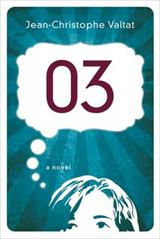
The reviewer does a good job here, describing the novella and offering her impressions in a clear and intriguing manner. Read the sample then bought the book (iPad‘s instant gratification has thinned my wallet). It’s odd, but for some time now translations have seemed more interesting to me than a lot of current English language literature. Saramago, Bolaño, Per Petterson, Ninni Holmqvist– the act of translation imparts a formality and strangeness to the text that I find very appealing.

at WORDS without BORDERS:

Jean-Christophe Valtat’s “03”
Reviewed by Emma Garman

In Jean-Christophe Valtat’s dazzling English-language debut, 03, a lyric from The Smiths’ Nowhere Fast sums up the narrator’s attitude toward feelings: “And if the day came when I felt a natural emotion / I’d get such a shock I’d probably lie / in the middle of the street and die.” This belief that emotions, ones worth having anyway, are the result of conscious decisions, “long and involved tactical maneuvers,” underpins his tortured yet exquisitely expressed subjectivity—where the reader is deliciously mired for the brief, spellbinding duration of this single-paragraph novella, in which a man remembers his seventeen-year-old self’s obsession with a developmentally-disabled girl.

Add to FacebookAdd to DiggAdd to Del.icio.usAdd to StumbleuponAdd to RedditAdd to BlinklistAdd to TwitterAdd to TechnoratiAdd to Yahoo BuzzAdd to Newsvine

1 Comment

Filed under Uncategorized

The Impact of Technology on Reading, pt. 2

A friend sent me a link to this article– some hope and some peril for small presses.

from Slate.com:

Byte-Sized Books
Digital publishing levels the playing field for small publishers.

Most small presses are labors of love, with money a secondary consideration. Independent publishers, who toe the delicate line between art and commerce, aren’t in the business of selling books to become the next Simon & Schuster. Often, these members of the little-guy economy are writers, poets, and designers eager to sustain and grow the communities they inhabit to satisfy the public’s creative needs. But no matter how far these jewels may be from Random House’s Broadway office, they share a stark reality with the big houses: They need to sell books to stay afloat.

*

Dorchester Publishing, whose Leisure Books division has published some entertaining Horror novels, has decided to go completely print-on-demand and digital.

from Murdoch’s rag, WSJ:

Mass Paperback Publisher Goes All Digital

The move comes at a time when electronic-book sales are gaining popularity with readers. Mike Shatzkin, chief executive of the Idea Logical Co., publishing consultants, predicts that digital books will be 20% to 25% of unit sales by the end of 2012, up from around 8% today.

The decision to go digital could be a sign of things to come for other small publishers facing declining sales in their traditional print business. Dorchester’s switch will likely result in significant savings at a time when it expects its digital sales to double in 2011.

*

And in case you haven’t seen this video:

Add to FacebookAdd to DiggAdd to Del.icio.usAdd to StumbleuponAdd to RedditAdd to BlinklistAdd to TwitterAdd to TechnoratiAdd to Yahoo BuzzAdd to Newsvine

Leave a comment

Filed under Uncategorized

Pointer #6 – anderbo.com

* Online lit mags are publishing some of the most intriguing writing available today. Every Monday, I post a pointer to a site that offers fiction and/or poetry either as free content or as samples from subscriber issues. Today’s pointer is to anderbo.com

“Anderbo, founded by . . . Rick Rofihe—who claimed he had never personally typed or sent an e-mail in his life—is a New York–based online (go figure) literary journal open to submissions from poets, prose writers, and photographers of all ages. Minimally designed to focus attention on the words . . . Anderbo received the 2005 Million Writers Award for best new online magazine, sponsored by storySouth, an online journal that ‘aims to prove that the Internet is not just a medium of flash and style; that excellent writing can attract attention without programming gimmicks and hard-to-read fonts.’ ” —Poets & Writers magazine, “Literary MagNet” section, July/ August 2007

from Six Questions For… :

SQF: What are the top three things you look for in a story and why?

RR: I want a story to start with either a little bit of action and go quickly to some background, or start with some brief background and then cut to some action. I want to know who the story’s protagonist is, and what his or her “conflict” is, within the first half-page. Then I want the rest of the story to narrowly follow whatever its beginning is.

Add to FacebookAdd to DiggAdd to Del.icio.usAdd to StumbleuponAdd to RedditAdd to BlinklistAdd to TwitterAdd to TechnoratiAdd to Yahoo BuzzAdd to Newsvine

Leave a comment

Filed under Uncategorized